THE IRON SENSEI JOURNAL
Karate. Health. Fitness. Psychology. Philosophy. Reflections from a Life in the Martial Arts.
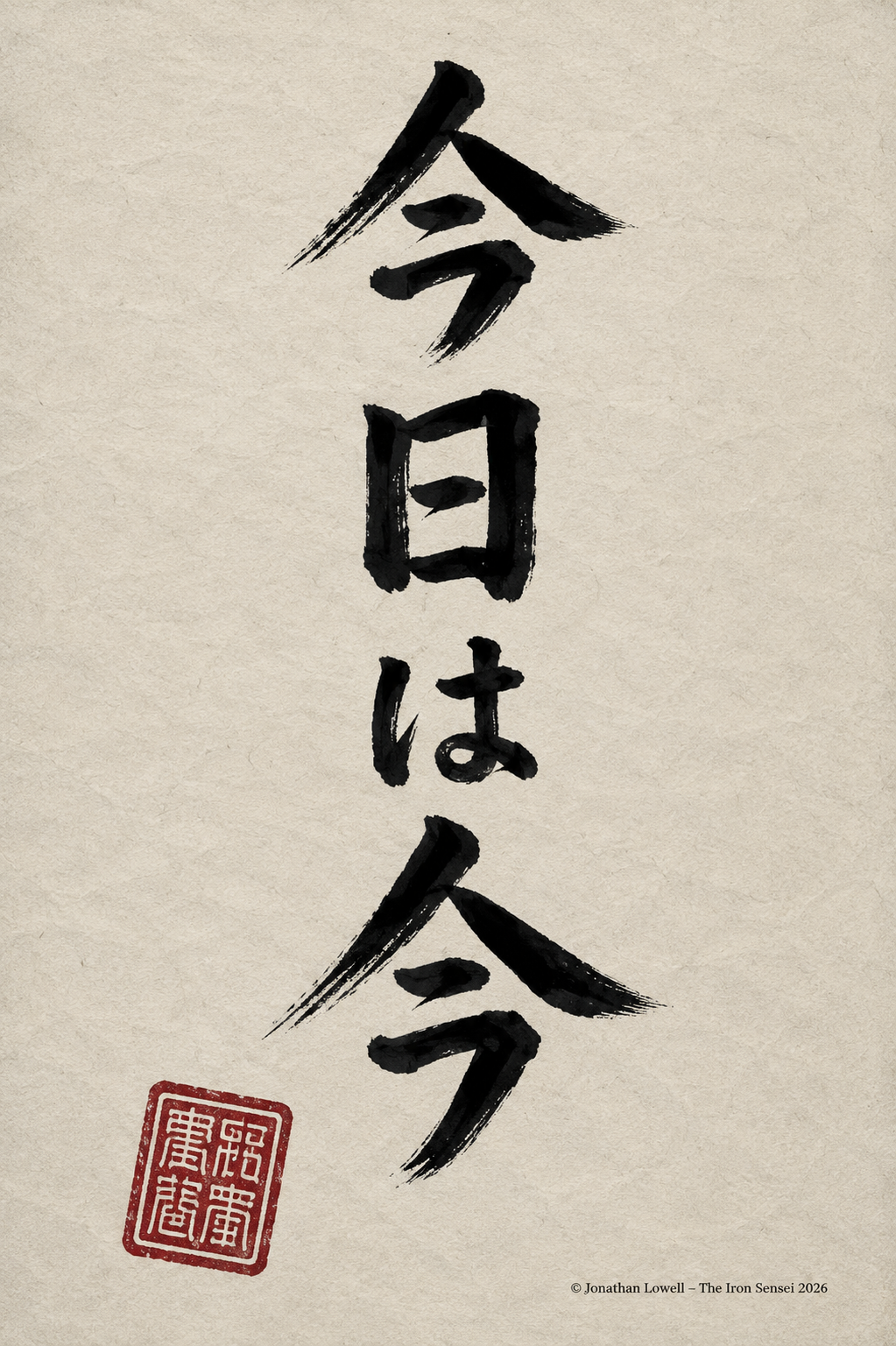
Today Is Now!
By Jonathan Lowell (The Iron Sensei)
For more than fifty years, I have studied under many remarkable martial artists. Some were exceptional teachers. Others were brilliant technicians, scholars, or professors of karate. From each I learned something that helped shape my understanding of the martial arts. But I had only one Sensei.
That was Peter Urban.
Urban's credentials alone secured his place in karate history. He was the first Westerner to earn a high dan rank under Gogen Yamaguchi, the legendary "Cat," and he played a pioneering role in introducing Goju-Ryu Karate to America, influencing generations of students who followed. Yet a résumé tells only part of the story.
He was also an artist of the Dadaist school, a musician, an unconventional thinker, and held a Ph.D. in Psychology. His mind never seemed content to stay within ordinary boundaries. Some people called him crazy. I always thought that if he'd been a millionaire, they would have called him eccentric. He later founded Zen Psychotherapy, combining Eastern philosophy with Western psychology in a way that reflected the unique way he looked at life.
Whatever history says about his karate, his personality, or the controversies that surrounded him, no one can take away what he gave me. He gave me my start. He taught me how to fight. More importantly, he taught me how to live.
One sentence he spoke has remained with me for more than fifty years:
"A black belt is learning how to take care of yourself really well."
When I was young, I thought he was talking about fighting. Today, I know he was talking about life.
That one sentence has guided me through karate, business, relationships, health, and growing older. Looking back, I realize that Sensei Urban wasn't teaching me how to win tournaments. He was teaching me how to become responsible for my own life.
That lesson brings us to the subject of this article.
Today Is Now!
Most people think Zen is about sitting cross-legged, burning incense, and saying mysterious things. It isn't.
Zen is reality.
Zen is learning to live completely in the present moment. Not tomorrow. Not yesterday. Right now.
The past is memory. The future is imagination. Life happens only now.
That sounds simple, but very few people actually live that way. Most people spend their lives worrying about tomorrow, regretting yesterday, or waiting for the "right time." There is no right time. There is only now.
That is one of the greatest lessons Sensei Urban ever taught me, although he rarely used the word "Zen." He simply lived it.
He had an expression that I have never forgotten. He called it shunting.
Shunting wasn't exactly procrastination, although procrastination was certainly part of it. Shunting meant avoiding responsibility. It meant knowing what needed to be done but pushing it aside because it was uncomfortable.
The dishes stay in the sink.
The bills don't get paid.
The workout gets skipped.
The difficult phone call never gets made.
The book never gets written.
Sound familiar?
We've all done it.
Urban had no patience for shunting. His attitude was simple. If something needed to be done, you did it. You didn't wait until tomorrow because tomorrow had a funny habit of never arriving.
Wash the dishes.
Pay the bills.
Train today.
Write today.
Make the phone call today.
Life is built one decision at a time.
That, to me, is Zen.
Not perfection.
Responsibility.
Awareness.
Action.
What Is Zen?
Most people think Zen is a religion. Others think it's some mysterious Eastern philosophy understood only by monks sitting on mountaintops.
I think they're both missing the point.
Zen traces its roots back more than 2,500 years to Siddhartha Gautama, the historical Buddha. The word itself began as the Sanskrit word dhyāna, meaning meditation. It became Chan in China and eventually Zen in Japan. But Zen has always been much more than meditation. It is a way of seeing reality clearly.
Unlike many religious traditions, Zen places less emphasis on belief and much greater emphasis on direct experience. Instead of asking, "What should I believe?" Zen asks, "What is happening right now?"
According to tradition, the Buddha once held up a flower during a sermon and said nothing. Only one disciple, Mahākāśyapa, smiled. That silent understanding became the symbolic beginning of Zen—a direct transmission from teacher to student beyond words.
Whether the story is historical or symbolic really doesn't matter. The lesson does. Reality cannot always be explained. Sometimes it has to be experienced.
That appealed deeply to the samurai of Japan. Life and death were everyday realities. There was no time for endless debate. You had to see clearly, remain calm, and act decisively.
That same mindset carries over into karate.
When someone throws a punch, you don't stop to analyze it.
You respond.
Immediately.
Completely.
Without hesitation.
That is Zen in motion.
Zen also teaches that ordinary life is the real dojo. Walking, eating, working, cleaning, training, listening, and even washing the dishes become opportunities to practice awareness. Every moment becomes training if you pay attention.
People often ask me whether Zen is a religion or a philosophy.
Historically, it is both.
But in my own life, Zen has become something very practical. It teaches responsibility. Discipline. Presence. Clear thinking. Personal growth. Those lessons belong to everyone, regardless of what religion they practice.
You don't have to become a monk.
You simply have to wake up.
Wake up to your habits.
Wake up to your excuses.
Wake up to your opportunities.
Wake up to your own life.
Because...
Today is now.
The Power of Now
The past is memory. The future is imagination. Life happens only now.
We all have a past. Some of it is wonderful. Some of it we wish had never happened. We all make mistakes. We all carry regrets. Learn from them, but don't live there. The past is a teacher, not a prison.
The future is important too. It is good to have dreams and goals. But dreaming without action is fantasy. Too many people spend their lives waiting for the perfect time to begin. They tell themselves, "I'll start next Monday. I'll start when I have more money. I'll start after the holidays. I'll start when I retire."
Before they know it, years have gone by.
The real question is much simpler.
What can I do today?
Can I walk another ten minutes? Can I add five pounds to the bar? Can I lose two pounds this month? Can I become a better father, husband, wife, friend, or student? Can I become just a little better than I was yesterday?
Life changes one decision at a time.
People sometimes ask me how I rebuilt my health after four heart attacks. The answer isn't dramatic. I didn't wake up one morning transformed. I trained one workout. I ate one good meal. I took one walk. Then I did it again the next day. Small decisions, repeated over time, become a different life.
That is the power of now.
Most people become overwhelmed because they look too far ahead. "I have to lose fifty pounds." "I have to write a book." "I have to change my whole life."
No, you don't.
You simply have to make one good decision. Then another. Then another. Mountains are climbed one step at a time. Lives are rebuilt exactly the same way.
DO • BE • HAVE
Over the years I've come to believe that most people have life backwards.
They think, "When I have enough money, then I'll be successful. Once I'm successful, then I'll do the things successful people do."
It doesn't work that way.
The order is exactly the opposite.
First you DO.
You train. You study. You work. You save. You write. You practice. You show up when you don't feel like showing up. Those actions slowly become habits.
Your habits become your character.
Eventually, you BE that person.
A disciplined person.
A healthier person.
A dependable person.
A successful person.
Only then do you begin to HAVE the things everyone else notices. The better body. The successful business. The black belt. The confidence. The respect.
People admire the results. They rarely see the thousands of ordinary decisions that produced them.
That is one of the great lessons of Zen. Stop chasing results. Concentrate on today's actions. If your actions are correct, the results will eventually take care of themselves.
Be an Implicit Actionist
Thinking is cheap. Action creates reality.
I don't care how many books you've read if you've never applied what you've learned. I don't care how many motivational videos you've watched if you never get off the couch. Knowledge without action is little more than entertainment.
Action is transformation.
One of the biggest lies we tell ourselves is, "I'm waiting until I'm ready."
Ready for what?
You'll never feel completely ready. The perfect moment doesn't exist.
If you're overweight, face reality. Don't blame your age, your metabolism, or your circumstances. Accept where you are, then begin. Walk. Lift weights. Eat one better meal. Make one better decision. Tomorrow, make another.
Pay attention to how you speak to yourself. If you constantly tell yourself you're old, fat, weak, or a failure, your mind begins to believe it.
Buddhism has a wonderful concept that can help anyone, regardless of religion: Mudra, Mantra, and Mandala.
Mudra is action. Move your body. Walk. Practice karate. Lift weights. Do yoga. Train.
Mantra is your self-talk. Every day you're carrying on a conversation with yourself. Make sure it's moving you toward the person you want to become instead of reminding you why you can't.
Mandala is inspiration. For a monk it may be a beautiful sand mandala. For you it may be a photograph of your family, your Sensei, your children, a great athlete, or anyone who reminds you of the person you're trying to become.
Move your body.
Guide your mind.
Feed your spirit.
Then get up...
...and do something.
Because today is now.
Master Taisen Deshimaru
One of my favorite Zen teachers is Master Taisen Deshimaru, who brought the Sōtō Zen tradition from Japan to Europe. He once said:
"Live as though your hair were on fire."
At first, that sounds dramatic. But he wasn't telling us to panic. He was teaching urgency.
Don't waste your life.
Don't postpone your dreams.
Don't keep telling yourself you'll start tomorrow.
Do something meaningful today.
Deshimaru also understood martial arts. Born into a samurai family, he practiced jujutsu and understood that the martial path was never simply about learning to fight. Like the sword masters of old, he believed the real battle was mastering your own mind.
That idea has stayed with me throughout my life.
My parents thought I was crazy for wanting to make a living teaching karate. Looking back, I understand why. It wasn't an easy path, and there were certainly easier ways to earn a paycheck.
But I never wanted an easy life.
I wanted a meaningful one.
Years ago, someone asked me a question I've never forgotten.
"If I gave you a million dollars, but in exchange you lost every martial arts experience you've ever had—every lesson, every student, every tournament, every memory—would you take it?"
The answer surprised even me.
No.
A million dollars would be wonderful.
But the experiences are priceless.
Money comes and goes.
The journey becomes part of who you are.
Perpetual Self-Improvement (PSI)
Sensei Urban often spoke about Perpetual Self-Improvement.
PSI.
That idea became one of the foundations of my own teaching.
Urban wanted his students to surpass him. He encouraged us to attend college, build careers, become professionals, and become experts in our own fields. He wasn't trying to create followers for life. He was trying to create independent, successful people.
That, to me, is the responsibility of every good teacher.
A Sensei should want the student to become better than the teacher.
Improve one thing every day.
Your body.
Your mind.
Your character.
Your spirit.
Read another chapter.
Learn another technique.
Walk another mile.
Help another person.
You don't have to become a completely different person overnight.
You simply have to become a slightly better version of yourself today than you were yesterday.
Do that often enough, and extraordinary things begin to happen.
The Now Generation
When I say The Now Generation, I'm not talking about the old slogan from the 1960s.
I'm talking about a way of living.
The Now Generation is made up of people who stop waiting for permission. They don't spend years making excuses. They don't blame their parents, their age, their circumstances, or bad luck. They accept reality, take responsibility, and begin.
Today.
One of the funniest stories I remember from Urban's dojo involved a man who desperately wanted his black belt. In karate, you never ask for rank. It comes when your teacher believes you're ready. But this student kept asking, and asking, and asking.
Finally, Urban wrote out the promotion certificate and said, "Come to black belt class."
The man came.
He quickly discovered he couldn't keep up with the black belts. He wasn't physically or mentally prepared for what the rank represented.
That was a lesson in Zen.
Reality doesn't care what we wish were true.
Reality simply is.
Eventually he did receive his certificate, but by then he understood something he hadn't understood before.
The belt was never the goal.
The person wearing it was.
That lesson has stayed with me ever since.
Closing
Life is short.
Death is long.
Those words aren't meant to frighten anyone. They're meant to remind us that our time here is limited.
There is no perfect moment.
There is no someday.
There is today.
Train today.
Write today.
Make the phone call today.
Tell your family you love them today.
Take responsibility today.
Don't compare yourself to other people. Everyone begins from a different place. Some have better genetics. Some have more money. Some have more talent. None of that changes what you have to do.
Your only competition is the person you were yesterday.
Become a little stronger.
A little wiser.
A little kinder.
A little more disciplined.
One decision.
One workout.
One page.
One act of courage.
That is how lives are changed.
When I was a young karate student, I thought my Sensei was teaching me how to fight.
After more than fifty years, I finally understand.
He was teaching me how to live.
Today is now.
Don't waste it.
About the Author
Jonathan Lowell ("The Iron Sensei") has trained in Goju-Ryu Karate-Do for more than 50 years. He is a martial artist, author, former school owner, personal trainer, and health coach who has taught thousands of students. Through The Iron Sensei Journal, he shares practical insights on karate, health, fitness, philosophy, and personal transformation to help others build strength in body, mind, and spirit.
© Jonathan Lowell 2026. All rights reserved.